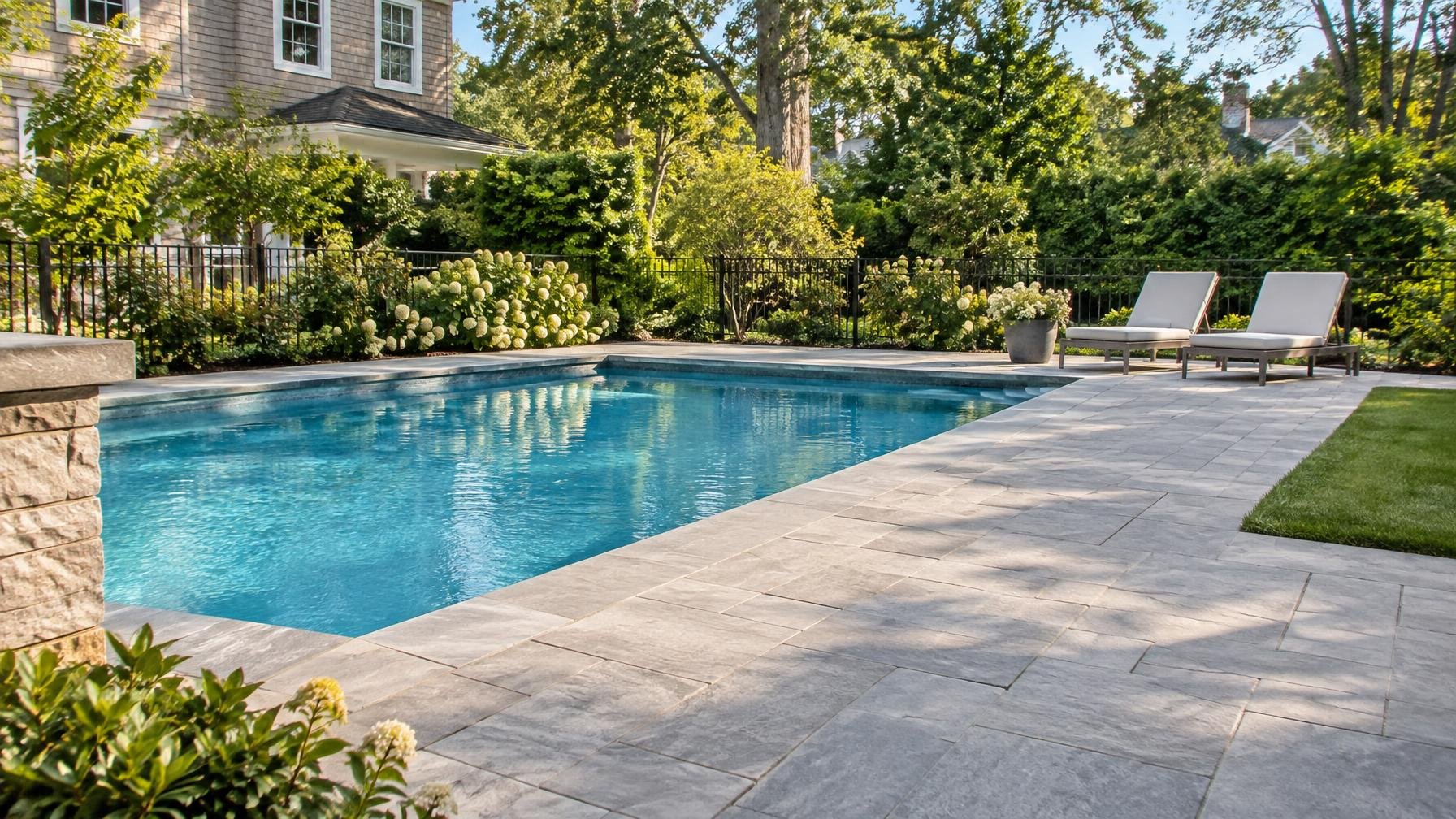
Choosing pool deck pavers in Great Neck, NY, means balancing wet-foot traction, barefoot comfort, drainage and the condition of the existing pool surround. StoneSky Pavers & Masonry offers pool deck paver services in Great Neck and across Nassau County, with free on-site estimates to assess the layout, materials and installation or repair needs.
Before choosing a color, look at how water leaves the deck, how the surface meets the pool coping and whether there is enough room to move safely around furniture and equipment.
Start With How You Use the Pool Area
A pool surround serves several purposes: access to the water, seating, a route through the backyard and space for maintenance. A layout that looks generous when empty can become cramped once loungers, umbrellas and a dining table are in place.
For a Great Neck backyard, measure the usable space between the pool, house, fences and planting beds. On a tighter property, a continuous walking route may matter more than a large sunbathing area. Where the yard has more room, place seating outside the main path rather than spreading furniture evenly around every side.
- Trace everyday routes: Include the back door, pool gate, steps, equipment area and storage location.
- Account for furniture in use: Chairs need space when pulled out, not just when tucked under a table.
- Keep access clear: Avoid covering equipment lids or making service points difficult to reach.
- Review gate movement: New surface elevations must not interfere with gate operation or required barrier clearances.
StoneSky’s pool deck paver services are a starting point for discussing a new surround or changes to an existing paved area.
Compare Pavers for Wet, Barefoot Conditions
Pool decks should be evaluated differently from driveways. Texture, surface temperature, edge profile and cleaning requirements deserve as much attention as appearance. No material is automatically slip-proof, and algae, sunscreen residue or an unsuitable sealer can change how a surface performs.
Concrete Pavers
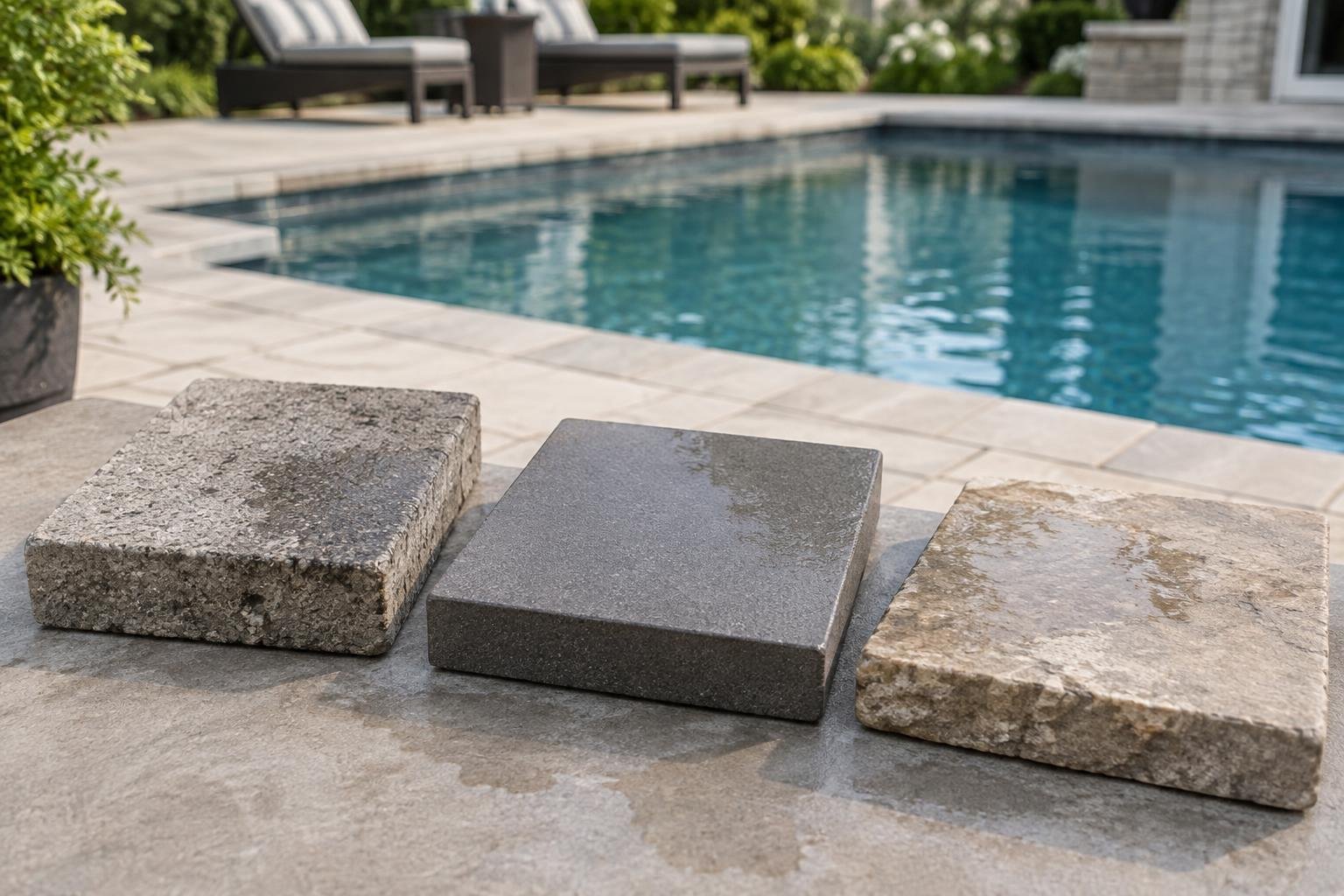
Concrete pavers offer a broad selection of sizes, colors and finishes. They can work well for a pool surround when the selected product is intended for that use and the installation provides stable support. Look at the actual face texture and edge treatment: pronounced bevels or irregular textures may feel different under bare feet than they look in a display.
Porcelain Pavers
Exterior porcelain pavers can provide a consistent appearance with relatively low water absorption. However, an indoor porcelain tile is not a substitute for a suitable outdoor pool-deck product. Ask about wet-use suitability, freeze-thaw exposure and the manufacturer’s required support system. Large-format units need careful planning around curved pool edges, drains and small cut pieces.
Natural Stone Pavers
Natural stone brings variation in color and texture, but performance differs by stone type and finish. Some surfaces can become slippery when wet, while others may require more attention to staining or weathering. Confirm that the specific stone is suitable for outdoor pool use in a climate with freezing temperatures.
Compare samples outdoors, both dry and wet. Lighter colors often absorb less solar heat than darker ones, but any surface can become hot in direct summer sun. Evaluate samples under comparable conditions rather than relying on a label such as “cool” or “non-slip.”
Plan Drainage Before Choosing the Pattern
Great Neck pool decks must handle rain as well as splash-out. A low spot near the pool can leave persistent puddles; a poorly planned slope can send water toward the house, a neighboring property or a location without a suitable outlet.
The layout should establish finished elevations and a drainage route before installation begins. Where gravity alone cannot direct water appropriately, a drain may be needed. Its location and discharge destination should be resolved as part of the project, not after the pavers are installed.
Check the Fixed Elevations
Pool coping, door thresholds, existing steps and nearby paved areas limit how much the deck can be raised or lowered. Simply adding pavers over an existing surface may create an awkward coping transition, reduce threshold clearance or change a step height. An overlay should only be considered after checking the existing structure, available clearance and drainage.
Understand What Permeable Pavers Require
Ordinary paver joints do not automatically make a deck a functioning permeable system. A designed permeable installation uses compatible pavers, joint material and an aggregate base that manages water below the surface. Soil conditions, groundwater, nearby structures and a suitable overflow route all affect feasibility.
If reducing surface runoff is a priority, discuss permeable paver options during the site visit. Permeable paving should not be treated as a shortcut around drainage planning or local approval requirements.
Give the Base, Coping and Edges Equal Attention
A finished surface can look level initially and still develop settlement if the support below it is inadequate. Excavation, subgrade conditions, base material and compaction should be matched to the chosen paving system and the site. Wet or disturbed soil near a pool deserves attention before it is covered.
Great Neck’s winter freeze-thaw cycles make water management particularly important. Water retained in poorly drained support layers can contribute to movement. A stable installation depends on the whole assembly, not just the thickness or appearance of the paver.
Keep the Coping Transition Deliberate
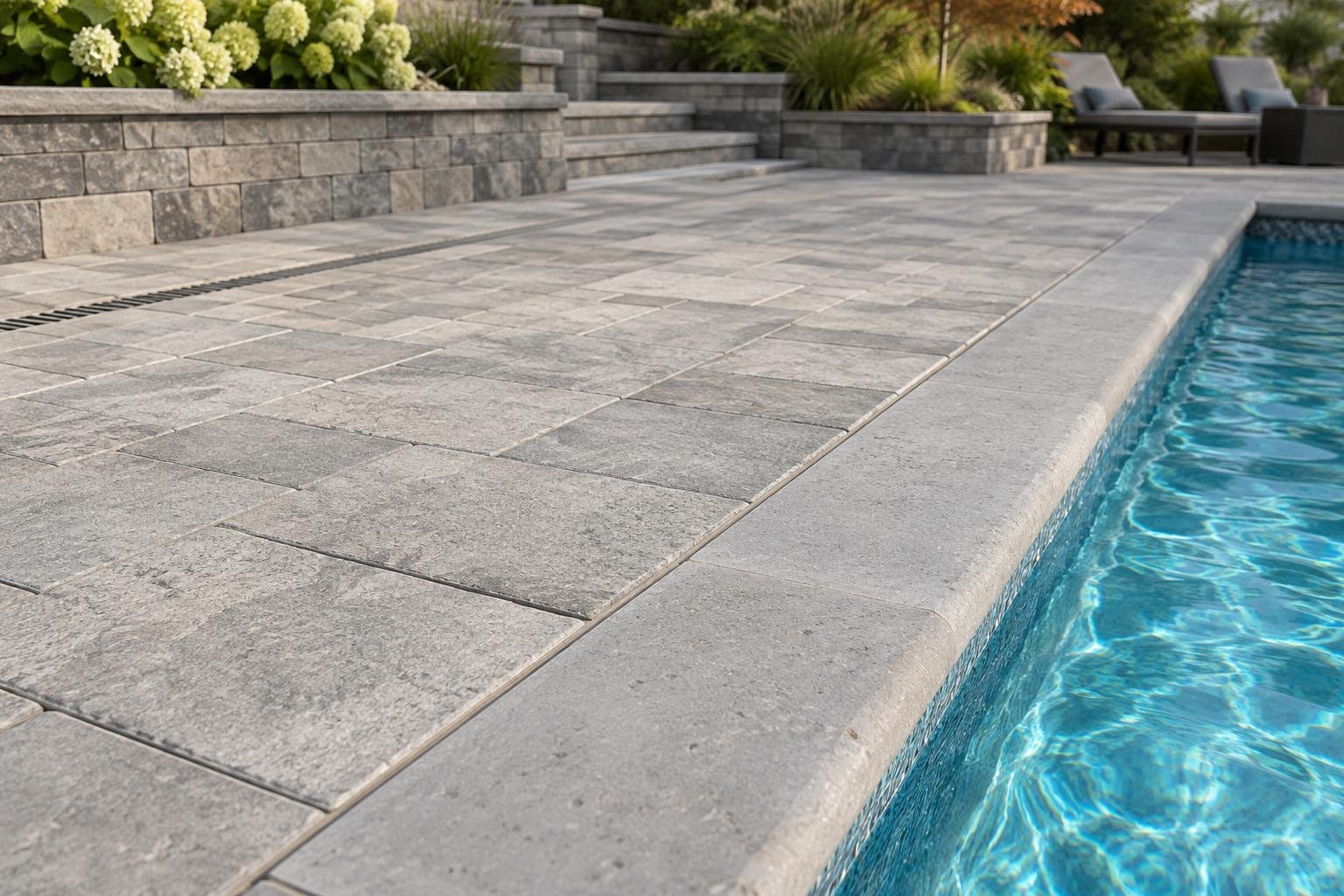
The coping is the edge directly around the pool. It may be sound enough to retain, or it may have loose pieces, damaged joints or movement that needs evaluation before adjacent paving begins. The deck should meet it cleanly without creating a raised lip that catches toes.
Have the contractor explain how the deck-to-coping joint will accommodate the selected materials and any required movement. Do not assume ordinary joint sand or mortar is appropriate for every connection. Suspected pool-shell or coping-support problems should be assessed by the appropriate pool professional before being concealed.
Support the Outside Edges
Pavers along lawns and planting beds need suitable restraint to limit spreading. Borders also need support around curves and narrow strips. Avoid layouts that leave tiny, vulnerable pieces at the pool edge or drainage grates simply to preserve a decorative pattern.
Repair and Reset, or Replace the Deck?
Not every uneven pool deck needs complete replacement. If the pavers remain serviceable and the problem is localized, lifting and resetting part of the surface may be an option. The important question is what caused the movement.
- A localized dip: Check for settlement, washout or a drainage problem before resetting.
- Spreading perimeter pavers: Evaluate the edge restraint and support along the border.
- Widespread unevenness: Review the base and overall grading rather than treating each low spot separately.
- Cracked or deteriorated units: Determine whether compatible replacements are available and why the damage occurred.
- Recurring wet areas: Rule out irrigation or pool-related leaks where appropriate before rebuilding the surface.
StoneSky provides paver repair and resetting. During an assessment, discuss whether existing units can be reused and how replacement pieces may differ in color from weathered pavers. Resetting can correct surface alignment, but it will not solve an unresolved leak or drainage issue by itself.
Check Great Neck Requirements and Project Access
A Great Neck mailing address does not identify every property’s permitting authority. Depending on the address, requirements may come from an incorporated village or the Town of North Hempstead. Confirm the applicable jurisdiction before changing deck coverage, grading, drainage or features near a pool barrier.
Ask the relevant building department whether the proposed scope requires permits or review. Existing pool-barrier requirements, lot coverage and drainage conditions may affect the plan. Replacing a surface in place and expanding a paved area should not be assumed to have identical requirements.
Access also affects the work sequence. Measure side gates, identify the route for removing old material and discuss where deliveries can be staged. Protecting the pool from construction debris and keeping equipment accessible should be part of the plan. Ask when the area can return to use based on the actual installation materials and conditions.
Keep Maintenance Simple and Consistent
Sweep leaves and soil from the deck before they collect in joints or stay wet against the surface. Address algae and organic buildup promptly with cleaning methods approved for the paving material, and direct cleaning runoff appropriately rather than into the pool.
Use pressure washing carefully: excessive pressure can remove joint material or damage some finishes. Sealing is not automatically necessary for every pool deck. If it is proposed, ask how the product affects wet traction, appearance and future maintenance. Follow manufacturer guidance for deicers, cleaners and winter care.
Request a Free On-Site Estimate in Great Neck
StoneSky Pavers & Masonry serves Great Neck, Nassau County, Queens and Long Island with paver installation, pool deck paving, repairs and maintenance. Have photos of ponding, examples of preferred materials and a list of layout concerns ready for the visit.
Request a free on-site estimate or call (929) 528-1205 to discuss your pool deck. Start with the existing elevations, drainage and surface condition, then choose a paving layout that fits your backyard.
Frequently Asked Questions
What are the best pavers for a pool deck in Great Neck?
The right choice depends on wet traction, barefoot comfort, sun exposure and maintenance preferences. Concrete, exterior porcelain and suitable natural stone can be considered, but the specific product must be appropriate for poolside use and local freeze-thaw conditions. Compare actual samples outdoors rather than choosing by appearance alone.
Can pool deck pavers be installed over existing concrete?
An overlay may be possible, but only after checking the concrete’s condition, drainage, coping height, door clearances and step transitions. Cracking, movement or insufficient clearance may make removal and reconstruction the better approach.
Can sunken pavers around a pool be repaired?
Localized settlement may be addressed by lifting the pavers, correcting the support below them and resetting the surface. The cause must be investigated first. An unresolved leak, washout or grading problem can cause movement to return.
Do I need a permit to replace pool deck pavers in Great Neck?
Requirements depend on the property’s jurisdiction and the scope of work. Confirm with the applicable incorporated village or Town of North Hempstead building department, especially if you are expanding coverage, changing drainage or working near a pool barrier.
Should pool deck pavers be sealed?
Not every paving material needs sealing. If sealing is recommended, confirm compatibility with the paver and ask how it may affect wet traction, color and maintenance. Cleaning and drainage issues should be addressed before applying a sealer.