
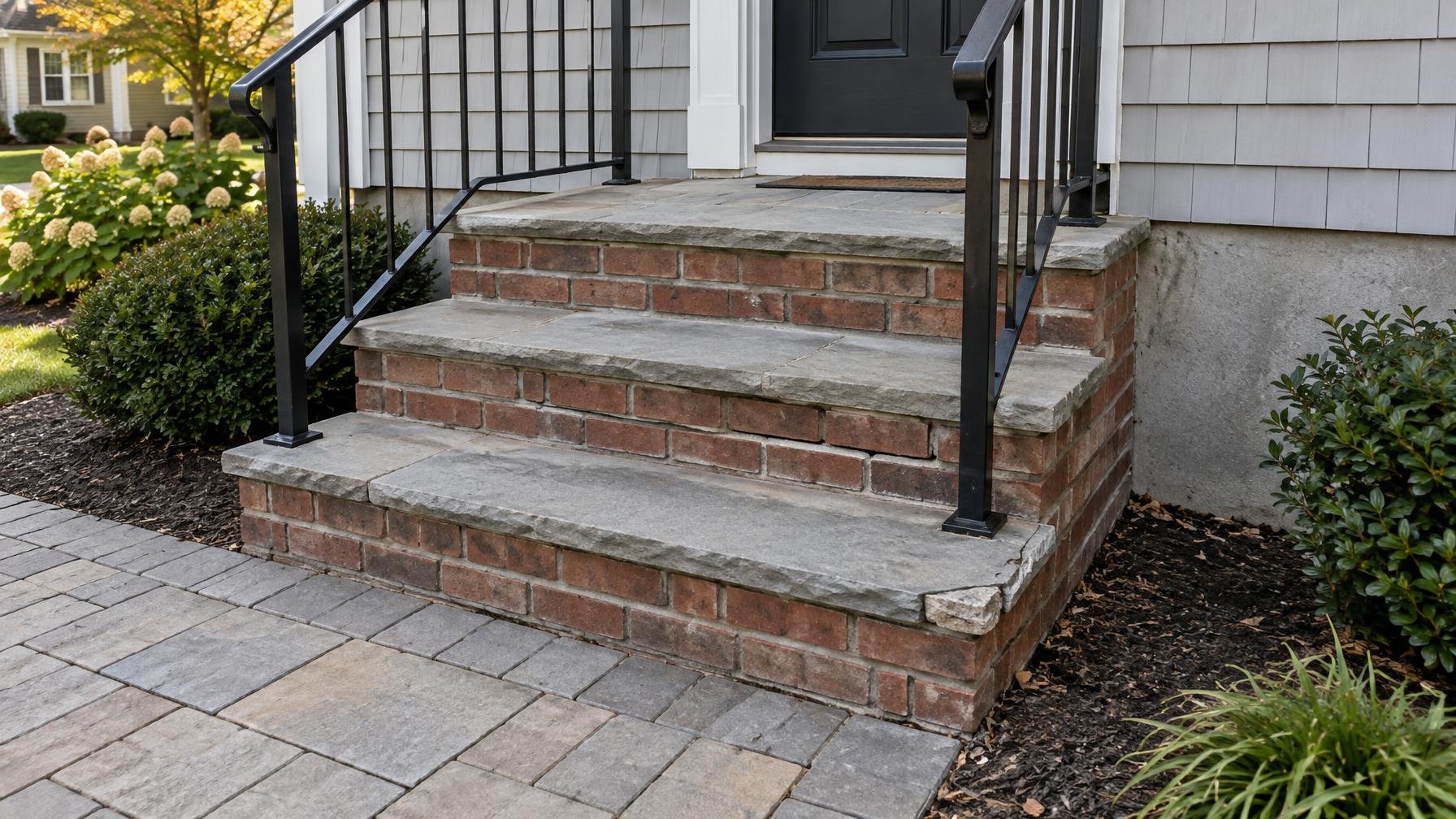
Masonry steps repair in Nassau County, NY starts with identifying whether the problem is limited to mortar and individual treads or extends into the stoop’s supporting structure. Loose walking surfaces, recurring cracks and sinking landings need more than a cosmetic patch. StoneSky Pavers & Masonry offers steps and stoops, brick repointing and concrete repair services, with free on-site estimates to assess the work needed.
Warning Signs Your Steps Need Attention
Entrance steps combine several components: treads, risers, a landing, supporting masonry and sometimes stone veneer or a concrete surface. A failure in one area can affect the others, so look at the whole entrance rather than only the most visible crack.
- Loose or rocking treads: Movement underfoot can indicate that a tread has separated from its setting material or that the support below has deteriorated.
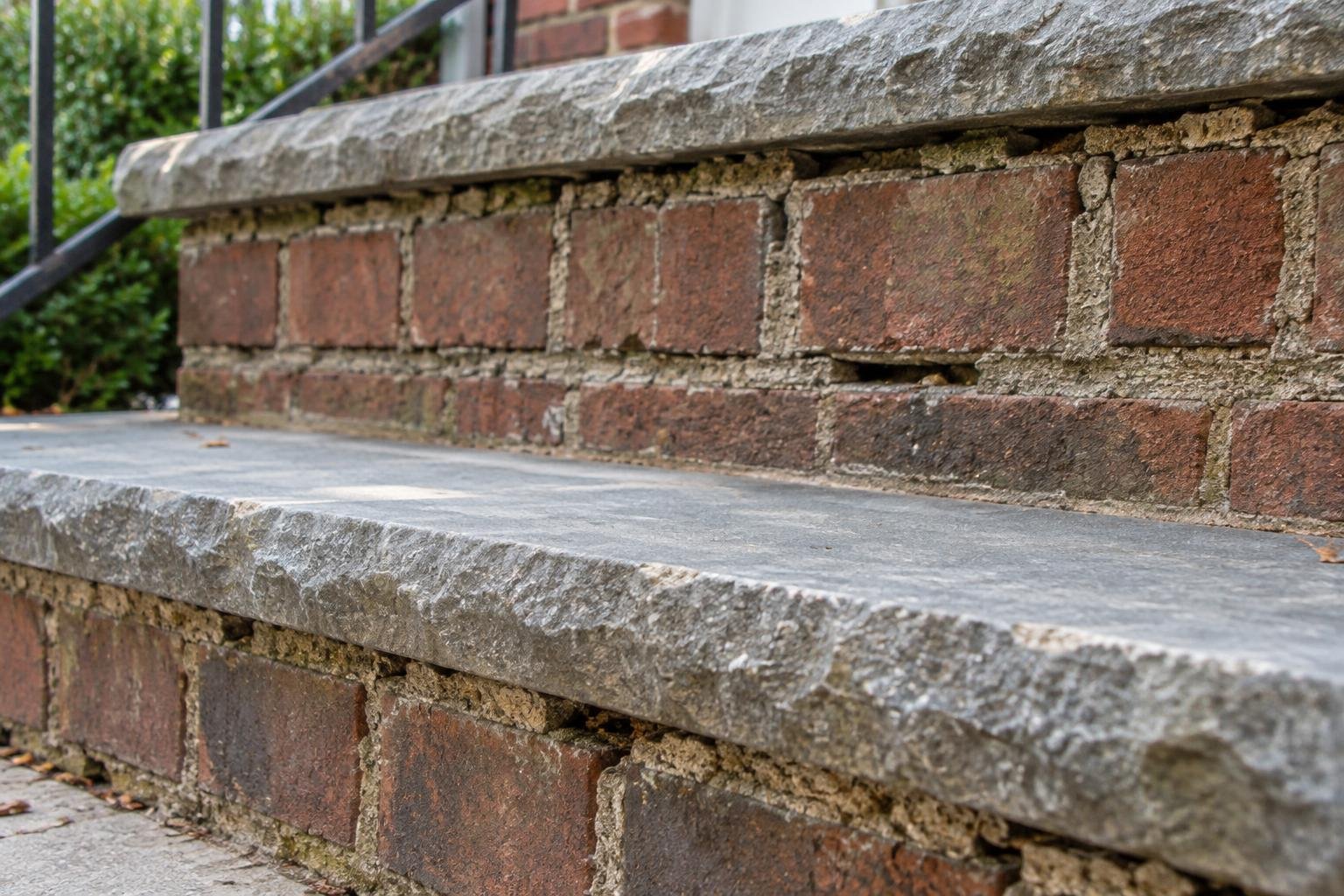
- Missing mortar: Open joints between bricks or stones allow water into the assembly and can leave individual units poorly supported.
- Flaking concrete or brick: Surface pieces breaking away, often called spalling, deserve inspection before they develop into deeper damage.
- Separation from the house: A widening gap may indicate movement or failure at the connection, not simply a joint that needs filling.
- Uneven step heights: Settlement, displaced treads or previous overlays can create an awkward and potentially hazardous walking pattern.
- Pooling water: Water lingering on a landing or tread suggests that pitch or drainage needs attention.
Do not deliberately rock a loose tread to test it. Keep people off unstable steps, use another entrance if available and arrange an assessment. A temporary patch should not be treated as proof that the entrance is safe.
Why Nassau County Steps Deteriorate
Water and freeze-thaw cycles
Nassau County’s winter freeze-thaw conditions are hard on masonry when water can enter open joints or damaged surfaces. Water freezes and expands, which can loosen mortar and worsen existing cracks. Repointing exposed joints may help address one entry point, but it will not correct a landing that repeatedly directs water into the same area.
Look above the steps as well as below them. An overflowing gutter, downspout discharge or roof drip line may concentrate water at the entrance. These conditions should be identified during planning, even if correcting them requires work outside the masonry repair scope.
Settlement and earlier alterations
A stoop can move differently from the house or the walkway in front of it. Poor support, water washing material away or deterioration within the assembly may contribute. Adding a new surface over an old landing without checking door clearance and step heights can also create problems.
In communities such as Garden City, Levittown and Hicksville, an entrance may have been altered during earlier renovations. The visible brick or stone does not necessarily reveal what supports it. An estimate should distinguish observable damage from concealed conditions that may become clear only after removal.
Repoint, Reset or Rebuild? Matching the Repair to the Damage
Repointing sound brick or stone masonry
Repointing means removing deteriorated mortar to an appropriate depth and replacing it with mortar suited to the existing masonry. It can be appropriate when the units remain sound and stable but their joints have weathered or opened.
Smearing a thin coat of mortar over the face of a failing joint does not address the weakened material underneath. Mortar selection matters, too: an overly hard mortar can be unsuitable for some older brick. Ask how the joints will be prepared and how the replacement mortar will be matched for compatibility and appearance.
Resetting or replacing individual treads
An intact tread may be a candidate for resetting if its support is stable and the setting bed can be properly restored. A cracked, badly chipped or deteriorated tread may need replacement instead. The work should account for bearing, attachment, pitch and alignment with neighboring steps.
Matching an existing stone is not always exact. Thickness, finish, edge profile and weathering all affect appearance. Compare available samples before approving a replacement, especially when only one tread in a prominent front entrance will change.
Repairing concrete steps
Localized concrete damage may be repairable when the surrounding material is sound. Proper preparation includes removing unsound material and using a repair approach appropriate to the location and depth. Patching over loose concrete leaves the weak layer in place.
Deep cracks, exposed corroding reinforcement or extensive deterioration may require a broader repair or replacement. If a previous patch keeps separating, ask what caused the failure before repeating the same treatment.
Rebuilding an unstable assembly
Widespread movement, failed support or several displaced components may make partial or complete rebuilding more appropriate than isolated repairs. Covering an unstable stoop with new veneer or treads does not restore its underlying support.
Where the condition raises structural concerns, additional evaluation may be needed before the work is defined. The goal is to establish a stable entrance, not simply hide the visible symptoms.
Plan the Steps and Walkway as One Entrance
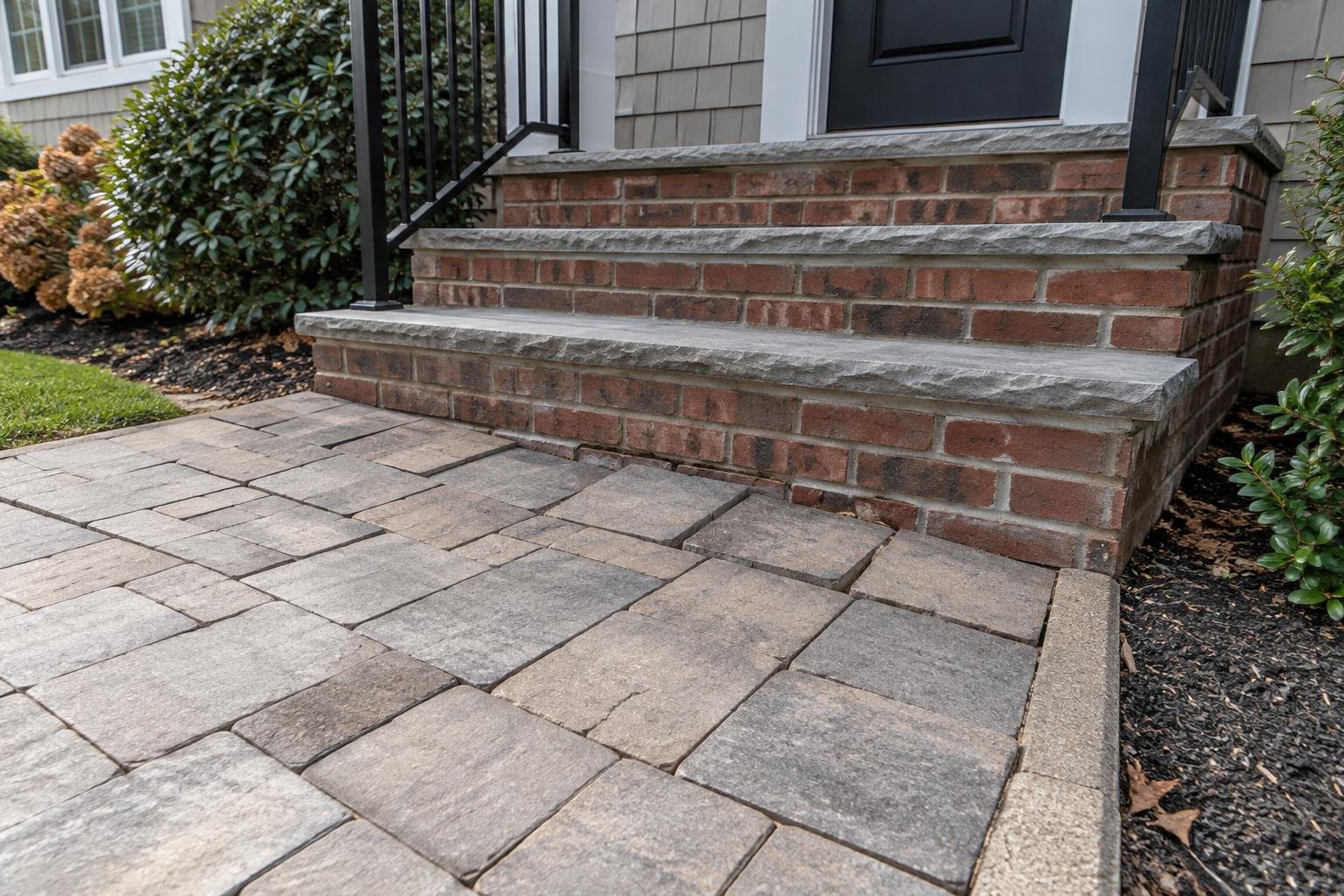
A repaired stoop still needs to meet the approach walkway correctly. If the walkway has settled at the bottom riser, the first step may be noticeably taller than the others. Raising that walkway without checking the full entrance can create a different problem by reducing the bottom step too much.
StoneSky’s paver repair and resetting services can be relevant where displaced pavers meet an otherwise repairable stoop. During the assessment, discuss both surfaces together rather than treating their shared edge as separate projects.
- Check that the landing allows the door to operate without striking the finished surface.
- Review tread and landing pitch so water does not collect against the house.
- Look for abrupt elevation changes where steps meet the walkway.
- Identify loose railings or damaged anchor locations and clarify how they will be addressed.
- Consider traction when selecting replacement tread finishes, especially for exposed entrances.
If the work expands into an entrance redesign, review front entrance paver options alongside the masonry scope. Coordinating elevations and materials before construction is more useful than trying to make them align afterward.
What to Check Before Work Starts in Nassau County
Local requirements depend on the property and scope
Nassau County properties fall under different town, city and incorporated village jurisdictions. A Great Neck mailing address, for example, is not enough by itself to establish which building department oversees a property. Confirm the actual jurisdiction rather than relying only on the postal address.
Ask the applicable building department whether the proposed work requires approval. Repointing existing masonry and rebuilding a stoop with changed dimensions may be treated differently. Changes affecting landings, guards, handrails or structural support can also affect the review. Do not assume that an existing entrance can automatically be rebuilt exactly as it stands.
Access and daily use need a plan
Explain whether the front steps are the household’s only practical entrance. Ask when the area will be unavailable, how it will be kept clear and when the repaired materials can be used. Fresh mortar, concrete and setting materials need appropriate curing conditions; a surface that looks finished may not be ready for foot traffic.
For homes with narrow side access or limited driveway space, discuss where removed material and new supplies will go. Protecting nearby pavers, landscaping and door thresholds should be part of the work plan, not an afterthought.
What a Useful Repair Estimate Should Explain
A clear estimate should identify the components being repaired and the limits of the work. Before comparing scopes, ask these questions:
- What is causing the damage? Ask whether the diagnosis points to joint deterioration, failed tread bedding, water exposure or movement.
- What stays and what comes out? Identify the treads, risers, bricks, concrete sections or landing areas included.
- How will materials be selected? Discuss mortar compatibility, tread dimensions, finish and reasonable matching limitations.
- Will elevations change? Clarify the effect on step heights, door clearance and the adjoining walkway.
- What happens if concealed damage is found? Agree on how additional work will be documented and approved.
- What aftercare is needed? Get instructions for curing, cleaning and winter maintenance suited to the materials used.
Photos taken after rain can help show where water collects. Older photos may also help establish whether a gap or leaning section has changed. Share these observations, but leave the repair diagnosis to an on-site assessment.
Request a Free On-Site Estimate for Your Masonry Steps
StoneSky Pavers & Masonry serves Nassau County, Queens and Long Island with steps and stoops, brick repointing, concrete repair and related hardscaping services. Whether your entrance has one loose tread or broader deterioration, start by identifying the cause and defining the repair scope.
Request a free on-site estimate or call (929) 528-1205. Share your location, the type of steps and the damage you have noticed so the entrance can be assessed as a complete assembly.
Frequently Asked Questions
Can loose masonry step treads be reset instead of replaced?
Sometimes. An intact tread may be reset if its supporting masonry is stable and the setting bed can be properly restored. Cracked or deteriorated treads may need replacement. Avoid using a loose tread until it has been assessed.
Will repointing fix a sinking stoop?
No. Repointing repairs deteriorated mortar joints, but it does not correct settlement or failed support. A sinking stoop needs an assessment of the underlying cause before the repair scope is chosen.
Do I need a permit for masonry step repairs in Nassau County?
Requirements depend on the property's town, city or incorporated village and the work proposed. Confirm with the applicable building department, particularly if rebuilding, changing dimensions or altering structural support, guards or handrails.
Why do cracks return after my steps are patched?
Recurring cracks may indicate ongoing movement, water entry, unsound material beneath the patch or an unsuitable repair method. Repeating a surface patch without addressing the cause may lead to another failure.
Does StoneSky offer free estimates for step and stoop repairs?
Yes. StoneSky Pavers & Masonry offers free on-site estimates and serves Nassau County, Queens and Long Island. Call (929) 528-1205 or use the contact page to request an assessment.